

Quarterly market commentary - December 2025


Following a volatile but generally profitable first three quarters of the year, the majority of markets delivered further gains over the final three months of 2025. International share markets provided the strongest gains, with the New Zealand and Australian share markets taking a back seat over the quarter.
Similarly, with global interest rates having receded from their post-Covid peaks, returns from fixed income assets delivered in line with expectations – moderately positive.
US politics and geopolitical events consistently dominated the daily news cycle, but investors can be, and should be, quite indifferent to much of what is broadcast in the mainstream news these days. While some news events can be genuinely confronting at a human level, more often than not they tend to have a minimal impact on corporate activity and long-term shareholder profits.
A quick note on Venezuela
It’s not strictly related to the December quarter, but the recent news as we write this newsletter is that on January 3rd, US troops carried out a pre-dawn raid into Caracas to capture Venezuelan President Nicolás Maduro and his wife Cilia Flores.
This unanticipated military action raises a multitude of questions, most notably how Venezuela will be governed in the absence of Maduro, and what role the US will play both diplomatically and militarily in the period ahead.
Based on media coverage to date, it seems US involvement is motivated by exerting greater control over Venezuelan oil and minerals resources, and less about ensuring greater drug enforcement.
How this evolves is anyone’s guess. The only thing we can say with any confidence is that, purely from an investment perspective, events in Venezuela are unlikely to have any material impact on investment markets.
The Venezuelan share market comprises a small collection of mainly banking, energy and agricultural companies, and the country is generally not a constituent in either the developed or emerging market funds that diversified investors are typically exposed to.
Watch for unintended concentration risks
An investment theme getting plenty of attention in recent times has been the growth and development of applications related to artificial intelligence, or AI. Excitement about the potential for AI to drive the next technological revolution has contributed to strong returns from a group of US tech giants and these returns helped push the US share market to a succession of record highs in 2025.
AI might very well revolutionise the world, but basing an entire investment strategy on a single theme is always risky. For those of us who lived and invested through the last technological transformation (the rise of the internet), it wasn’t much fun for investors who were heavily concentrated in technology stocks during the dot-com crash of 2001. Although all markets were impacted to some extent as the technology bubble unwound, our loyal friend – diversification – proved to be a wonderful ally.
Today, the seven most influential US tech giants (Nvidia, Apple, Microsoft, Alphabet, Amazon, Broadcom and Meta) comprise around 35% of the market cap of the S&P 500 Index. According to JP Morgan data, there is a wider group of 41 ‘AI-related’ companies within the S&P 500 (i.e. companies either directly developing software, semiconductors, or considered integral to the AI ecosystem). These 41 companies together comprise more than 45% of the total market capitalisation of the S&P 500. That’s a very significant proportion and something we all need to be aware of as they consider what a prudent asset allocation might look like.
Beyond developed markets
Developed share markets have performed extremely well over the last 15 years. In part that was due to a strong rebound from the lows of the Global Financial Crisis and, more recently, it has been helped by excellent returns from a few large US-based technology firms. With developed markets performing so well, it’s been easy to forget that emerging markets, while lagging recently, have been a superior performer over longer timeframes.
The chart below shows the difference in rolling twelve month returns between the emerging markets (including countries like China, India, Korea and Brazil) and the traditional developed markets (including USA, UK, Japan, Australia and New Zealand).
Since 1988, the segments in green are when the emerging markets have outperformed developed markets. The segments in blue are when developed markets have outperformed.
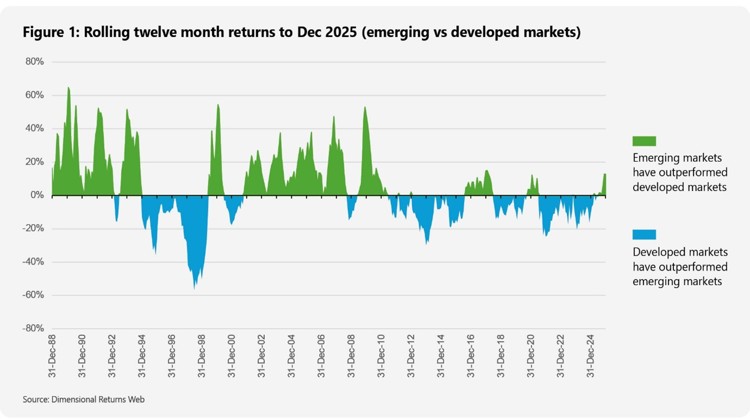
There are at least two interesting aspects to this data:
- Although developed markets have largely been winning over the last decade, the emerging markets were generally outperforming developed markets in 2025.
- While it’s not easily discernible from the chart, over the entire time period (since the beginning of 1988) emerging markets have actually outperformed developed markets by an average of 1.2% p.a.
It’s intuitive that countries with faster economic growth may offer opportunities for larger investment returns and that has certainly been the case with emerging markets. Not all the time, but definitely over time.
Although the emerging markets often command fewer investment headlines, from a diversification perspective they have never lost their appeal.
The recovery that never quite arrived (but might in 2026)
For many households and businesses in New Zealand, 2025 was a trying year. Despite a much-anticipated economic recovery, the reality turned out to be sluggish growth, higher costs and persistent uncertainty.
Consumer spending stayed weak as households absorbed the cumulative impact of earlier interest rate hikes and uncomfortably high living costs. All of this contributed to concerns about job security and reducing consumer confidence.
With annual consumer price inflation remaining within the Reserve Bank of New Zealand’s (RBNZ) 1-3% target range, the RBNZ continued to cut interest rates to stimulate domestic demand.
By late 2025, sales and hiring were picking up and consumer spending was rising, suggesting the economy was finally regaining some overdue momentum. We’ll know for sure in March, when the official GDP numbers for the fourth quarter are released.
Looking ahead, the RBNZ is projecting a modest recovery taking hold in New Zealand and most independent forecasts are also pointing to a gradual acceleration in economic activity in 2026.
It won’t all be plain sailing as many of the issues weighing on the economy in 2025 haven’t magically vanished. This includes fragile business confidence and ongoing global trade uncertainty, in particular the US-driven move towards greater trade protectionism.
However, it is reasonable to be cautiously optimistic that many of the foundations for a slow and steady economic recovery in New Zealand are now in place.
A return to relatively stable global interest rates
Globally, the response to Covid-19 saw aggressive monetary policy easing, including slashing interest rates, alongside a massive, coordinated increase in government spending.
While it’s generally argued this response was necessary to prevent a deeper economic crisis, this ‘cheap money’ ultimately coalesced into a different problem - an explosive post-Covid spending spree. Coming out of Covid, and with many more dollars chasing a still-restricted supply of goods, we experienced an unwelcome inflationary surge. It was this ‘cost-of-living crisis’ that required central banks to sharply raise interest rates once more in an effort to contain price rises.
Now that inflation is largely under control again and GDP growth rates have slowed, central banks are mostly now cutting short term interest rates. This will provide welcome added relief for consumers and mortgage holders.
But bond investors are also better placed than before, particularly if they are willing to accept some additional duration risk.
As we can see in the chart below, US and New Zealand 10-year government bonds are currently trading at yields not seen in over a decade. In addition, these 10-year yields appear to be a little more stable than they have been for some time.
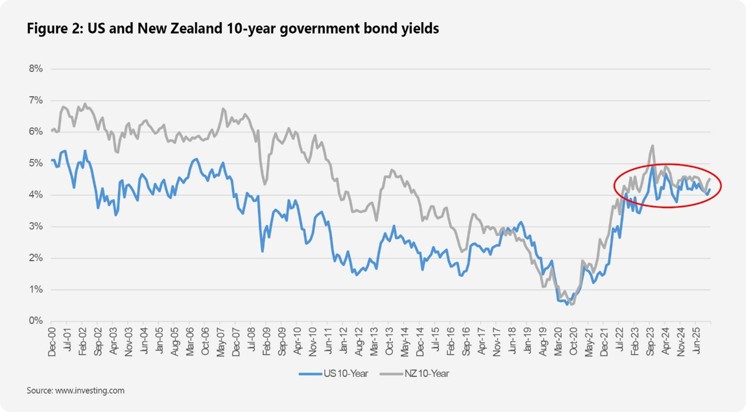
In the context of the last few years when interest rates and bond yields have (quite often) been unusually volatile, this is a much more favourable scenario for investors looking to include traditional lower risk fixed income assets in their portfolios.
The road ahead
The recent unexpected incursion into Venezuela is a timely reminder of the futility of putting too much weight on forecasting. While this event is largely disconnected from investment markets, the next unpredictable event may not be. However, when, where or what that event might be, is something we simply cannot know.
So, we do what we always do, which is to invest as prudently as we can while we wait for the inevitable, unknowable future events to occur. Part of our protection, while we wait, is to ensure we only buy high quality, highly liquid assets that are less likely to become illiquid in times of market stress. The other critical element is to diversify widely. If parts of the markets are affected more than others in a future event, diversification ensures that we do not have too many of our assets exposed to the exact same (poor) outcome.
2026 will bring further intrigue internationally, in particular in the US where the scheduled mid-year replacement of Jerome Powell as Federal Reserve Chairman and the US mid-term elections in November both loom as headline-dominating events.
In both cases there will be some change to the status quo. However, the extent to which these changes will impact either the independence of the Federal Reserve or the degree of Congressional oversight provided to the White House, only time will tell.
In any event, the one thing we have learned over many years is that no matter how hyped these events are in the lead-up, they will end up being fish and chip paper the next day. The markets will continue to absorb and respond to new information as it arises. And, as long-term strategic investors, we will continue to allocate sensibly, diversify widely, and go along for the ride.
Click here to view the full newsletter in PDF
For a detailed review of the asset class performances for the quarter, see ‘Key market movements - December 2025’
Disclaimer
While every care has been taken in the preparation of this newsletter, Consilium makes no representation or warranty as to the accuracy or completeness of the information contained in it and does not accept any liability for reliance on it. Information contained in this newsletter does not constitute personalised financial advice and does not take into account your individual circumstances or objectives.
-

Key market movements - December 2025
The quarter delivered steady gains across most asset classes, with international shares leading returns and emerging markets outperforming developed peers. Bond markets diverged across regions, reflecting differing central bank paths, while New Zealand and Australian equities lagged global markets.
-

Why every long-term investor should study ancient architecture
What do the Pantheon, Notre-Dame and the Taj Mahal have in common with successful long-term investing? More than you might think. This article explores how ancient architectural masterpieces were built to endure and what this can teach modern investors.