
Why every long-term investor should study ancient architecture


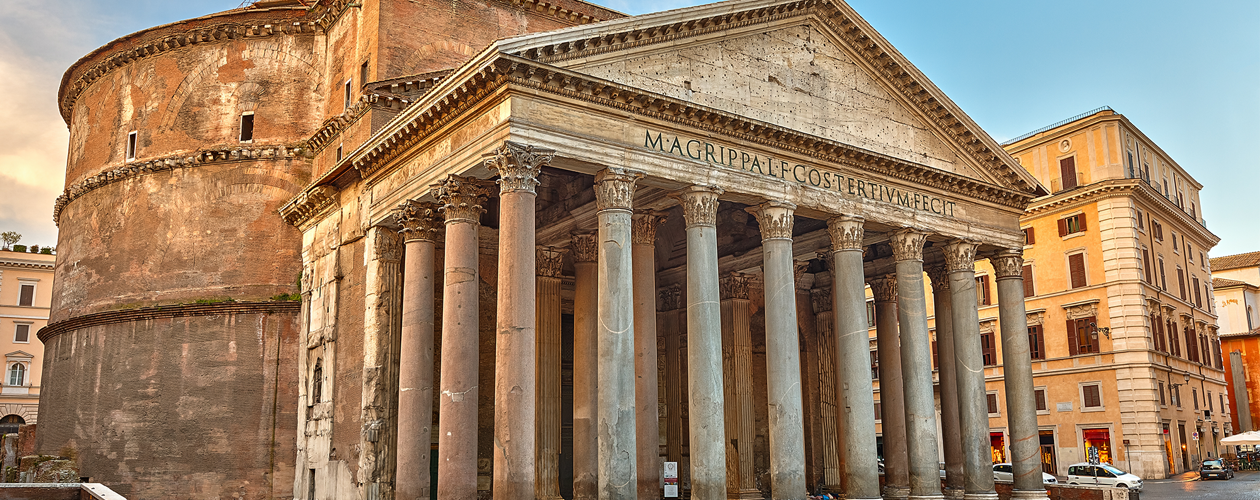
The Pantheon in Rome, completed almost 2,000 years ago, stands as one of the greatest engineering marvels of the ancient world. The structure is a testament to human ingenuity and careful planning. And its architecture, in particular, could hold a few key insights for any modern business leader or investor looking to build something enduring.
Consider, for instance, how the Pantheon’s architects used a form of Roman concrete (opus caementicium), which combined volcanic ash (pozzolana), lime, and water. This mix made the concrete both durable and lighter, essential for supporting the massive dome. Coffering, or recessed panels, reduced the dome’s weight and added structural support. The project took over a decade to complete, requiring a commitment to both craftsmanship and materials that would endure. It’s safe to say Rome was quite literally not built overnight, and certainly the Pantheon’s lasting power suggests that good things truly do take time.
In fact, the Pantheon’s endurance is so remarkable that a team of investigative geologists from MIT, Harvard University — and laboratories across Italy and Switzerland — actually published a study on ancient Rome’s concrete. “Because of this proven longevity on the order of millennia,” the researchers wrote, “these ancient construction materials are attractive model systems for… modern engineering applications.”
Perhaps modern leaders could learn something from the report. The Pantheon’s enduring strength is a powerful reminder that true longevity is rooted in careful planning, innovation — and a vision that extends beyond the immediate. But the Pantheon is not alone. Many ancient architectural masterpieces hold timeless insights for creating lasting structures, whether in architecture, business or investing.
Here, we explore a few more of those key principles.
The value of stability over constant growth
Any first-year architecture student understands the value of stability to any structure’s survival. And rock-solid foundations, both literally and figuratively, are key to longevity. Consider a gothic cathedral like Notre-Dame in Paris, whose construction began in 1163 and spanned over 180 years. Generations of builders worked on these monumental projects, each phase completed to ensure the structure could endure. Notre-Dame has survived wars, fires and natural aging — most recently, the devastating 2019 fire — thanks to its stable foundations. Notre Dame’s walls, constructed from Lutetian limestone (a durable material resistant to erosion) were reinforced by flying buttresses to bear heavy loads and to disperse stress, which preserves the structure through extensive damage.
Similarly, Hagia Sophia in Istanbul, built in 537 AD as a Byzantine cathedral, stands as another testament to stability. Its massive dome was made possible by using lighter materials like brick and mortar rather than heavy stone. Builders incorporated crushed brick and ash into the mortar, creating a more flexible structure that could absorb shocks from frequent earthquakes. Despite multiple regime changes, earthquakes, and structural repairs following early collapses, Hagia Sophia’s foundational engineering has allowed it to stand resiliently for nearly 1,500 years.
For investors, stability over relentless growth offers a similar advantage. Investments grounded in long-term principles — a clear mission and enduring values — are often more resilient than those chasing rapid expansion or short-lived trends. And just as stability forms a crucial foundation, so too does craftsmanship — the attention to detail and commitment to quality that imbue an organisation with lasting strength.
Purpose and identity: foundations of longevity
Enduring structures like the Taj Mahal reveal how a clear purpose and mission can resonate across generations. The Taj Mahal, completed in 1653, is an architectural marvel and a symbol of love, with every detail designed to inspire awe. The clarity of purpose behind the Taj Mahal’s creation has resonated for centuries, attracting millions of visitors each year and cementing its place as one of the world’s most celebrated works of architecture.
A defined purpose or mission is crucial for investors as well. A strong identity — whether focused on environmental protection, innovation or community — can anchor an investor through economic downturns.
A few key takeaways
- Prioritise stability over rapid growth. Just as ancient structures rely on solid foundations, investment strategies benefit from focusing on stability and long-term returns rather than quick expansion or the latest investment fad.
- Embrace simplicity as a source of strength. Simple architectural forms, like the Parthenon’s Doric columns, endure by resisting unnecessary complexity. When investing, streamlined investment strategies and clear investment goals are often more resilient.
- Adapt without compromising core identity. The Great Wall evolved without losing its core purpose. Similarly, investment strategies that adapt to different life stages while maintaining core values can have real impact over the long-term.
- Anchor success in purpose and identity. The Taj Mahal’s timeless appeal is rooted in its clear purpose. Similarly, investment strategies with strong, purpose-driven identities can deliver enduring performance over time.
In a world often focused on the ephemeral, these architectural lessons remind us that true success lies in what endures.
Originally published on www.bigthink.com
-

Quarterly market commentary - December 2025
Markets remained resilient through the final quarter of 2025, supported by easing monetary policy and solid international equity performance. This economic commentary looks at what’s driving returns and the outlook as political and geopolitical events continue to dominate headlines.
-

Key market movements - December 2025
The quarter delivered steady gains across most asset classes, with international shares leading returns and emerging markets outperforming developed peers. Bond markets diverged across regions, reflecting differing central bank paths, while New Zealand and Australian equities lagged global markets.